Learning Blog #2

The focus of my inquiry this semester will be how can I Implement disciplinary learning in my third grade classroom. I have already learned so much from my research in the last two weeks. I have begun to implement my findings in my classroom already. The students in my third grade class have not been introduced to many informational text other than what has been in their reading book, due to the behaviors that were occurring in the classroom. I have been able to introduce different text features and forms of informational text since becoming their teacher. The anchor standard that I focused on this week was RI/RS/RST R9 Analyze how two or more texts address similar themes or topics in order to build knowledgeable or to compare the approaches authors take. The artifact that I found was on readwritethink.org and it was a virtual Venn diagram. The students have been introduced to Venn diagrams before, but it has always been paper and pencil form. I tried this artifact during our writing time this week. We were able to compare two different biographies about Ted Geisel. I felt like my students were more engaged with the Venn diagram being on the smartboard rather than paper and pencil form. One suggestion that Shanahan mentioned in his article Does Disciplinary Literacy have a Place in Elementary School? was that students need to be introduced to more informational text. (Shanahan,C.,&Shanahan,T. (2014) )  I have been trying to integrate more informational text when we are studying a new topic, but I am finding this process hard because it has not been something we have been doing all year.

Learning Blog #1

Disciplinary Literacy Learning Blog #1

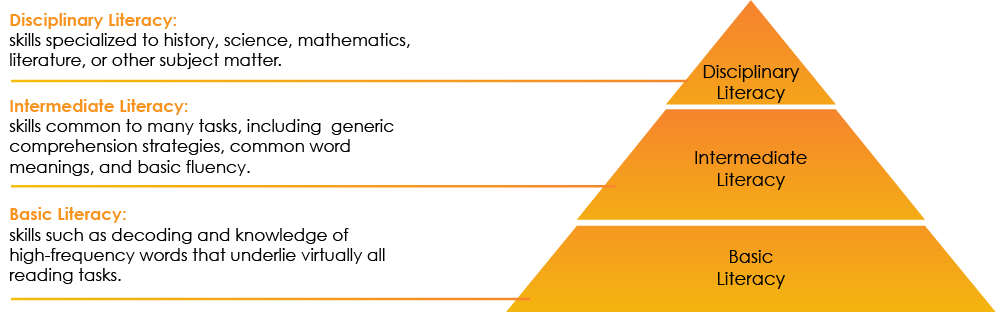
Cynthia Shanahan defines disciplinary literacy as the “idea that we should teach the specialized ways of reading, understanding, and thinking used in each academic discipline, such as science, history , or literature. (Shanahan,C.,& Shanahan,T.(2014)) Disciplinary literacy is used to teach students how to read specific content literature. For example, historians need to be able to read documents from the time in which they are studying and other secondary sources. On the other hand, scientists rely more on data and, observations and other experiments.

Disciplinary literacy is different than content area reading in many ways. Disciplinary literacy has the student learn the content of the field and how writing/ reading are used in the specific field. Content area reading on the other hand, focuses more on study habits that will help students to have better comprehension of the topic.

The focus of my inquiry this semester will be how can I Implement disciplinary learning in my third grade classroom. I will be specifically looking at resources, standards and strategies for readers when approaching content areas through the disciplinary approach. The text in which I plan to use throughout this learning experience is Altieri, J.  (2013). Powerful content connections: Nurturing readers, writers and thinkers in Grades K-3.  Newark, DE: International Literacy Association.

            The students in my class currently struggle with reading. I have several students that are low level readers. On the other hand, I have several students that are advanced readers also. I am curious to see how introducing more informational text for each subject will affect the different learners in my classroom.

Shanahan, C., & Shanahan, T. (2014). Does disciplinary literacy have a place in elementary school? The Reading Teacher, 67, 8, 636-639.

Check out this infographic by Kasey Dunlap, Kyle Lefier, Caleb Kuhlman, Andrew Scherer, Corey Jennett and Brandon Lamarche

https://www.thinglink.com/scene/695850131886440449 .